

Asia Euro Tourism, Hospitality and Gastronomy Conference comes to Maldives: What hoteliers need to know
When Villa College hosts the ninth Asia Euro Tourism, Hospitality and Gastronomy Conference from 10 to 12 May 2026, it will mark the first time the Maldives has served as the venue for this established international academic and industry gathering.
Organised in collaboration with the School of Hospitality, Tourism and Events at Taylor’s University in Malaysia and ISTHIA at Université Toulouse Jean Jaurès in France, the conference operates under the theme of “Redefining Impact: Advancing Sustainable Innovation for the Future.” For hospitality professionals operating in one of the world’s most environmentally sensitive destinations, the timing and subject matter are directly relevant to the strategic decisions facing their businesses today.
The conference’s central argument, reflected across its thematic scope, is that sustainable innovation has moved well beyond the realm of corporate social responsibility and into the domain of commercial necessity. For Maldivian resorts, where the natural environment is not merely a backdrop but the core product, this distinction carries particular weight. A property that embeds sustainable sourcing into its food and beverage operations is simultaneously meeting responsible consumption standards and satisfying increasingly rigorous corporate reporting requirements from institutional investors and corporate travel buyers. By contrast, properties that treat sustainability as a marketing overlay rather than an operational commitment face mounting scrutiny from travelers who are more capable of identifying superficial environmental claims. The conference frames this contrast clearly: alignment between global frameworks such as the United Nations Sustainable Development Goals (SDGs) and the broader 2030 Agenda they underpin, Environmental, Social, and Governance (ESG) principles, and the Global Sustainable Tourism Criteria (GSTC) on one side, and daily commercial realities on the other, is no longer aspirational but structurally necessary for long-term market viability.
Understanding the regulatory environment is a practical concern for any hospitality operator, and particularly so in destinations where environmental vulnerability and tourism dependence are intertwined. The conference agenda addresses this directly, with keynote speaker Dr Abdulla Niyaz, the Minister of State for Tourism and Environment, drawing on his background in governance, quality assurance, and disaster management to examine ethical leadership and accountability mechanisms. In the Maldives, where rising sea levels and coral degradation represent immediate operational risks rather than distant projections, disaster preparedness and regulatory compliance are not abstract considerations. Industry leaders who engage with these discussions gain an informed vantage point from which to anticipate future regulatory frameworks and position their properties accordingly, rather than reacting to policy changes after they have taken effect.
The conference broadens its analytical scope to address the structural economic dimensions of tourism in vulnerable small island states. Professor Dr François Vellas, whose work spans engagements with the United Nations and the G20, will address how tourism economies in such contexts can be designed for enduring resilience. This perspective is valuable for Maldivian hoteliers navigating the pressures of luxury market competition alongside the macroeconomic fragility that characterises island destinations with high tourism dependence. Resilience in this sense is not simply about weathering disruption; it encompasses the capacity to build economic models that distribute benefits more inclusively and remain viable across a range of environmental and market conditions.
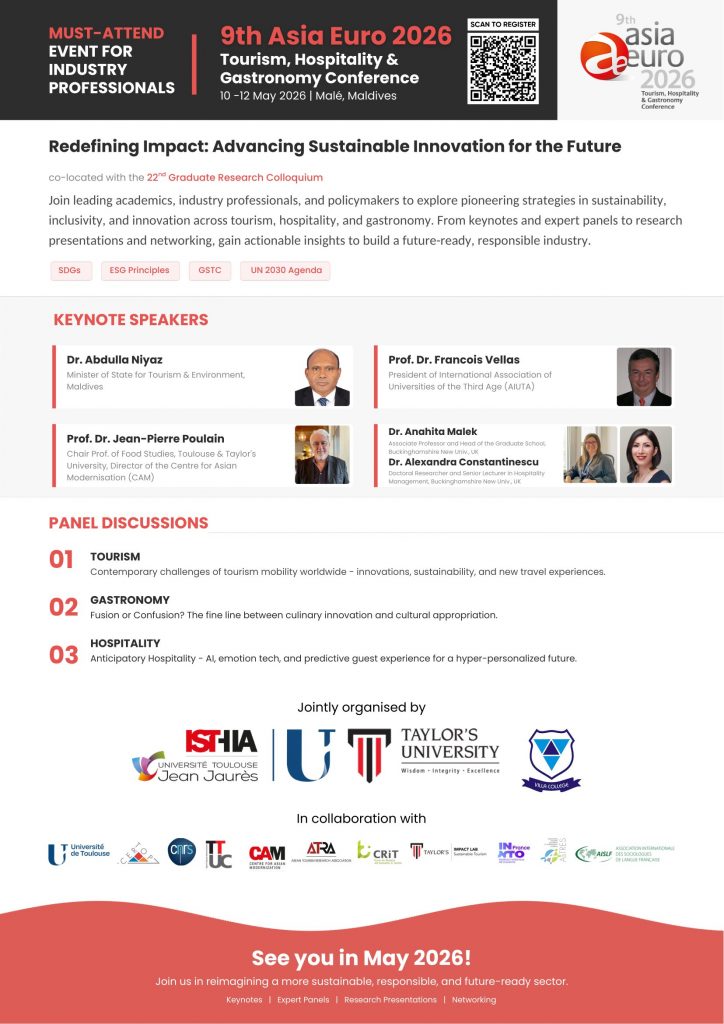
One of the more actionable dimensions of the conference programme involves the role of food and gastronomy in resort experiences. Professor Dr Jean-Pierre Poulain, alongside Associate Professor Dr Anahita Malek and Dr Alexandra Constantinescu, will examine how local food traditions can be authentically integrated into resort dining rather than merely referenced decoratively. Their collective research on gastronomic acculturation and place-making provides a framework for hoteliers to think about dining not simply as a revenue stream or a guest satisfaction metric, but as a mechanism for cultural preservation and community empowerment. When implemented thoughtfully, this approach ensures that host communities derive meaningful and inclusive benefits from tourism activities, addressing one of the more persistent critiques of high-end resort models in small island destinations.
Beyond the keynote sessions, the conference will be structured around three panel discussions that address pressing questions across the sectors. The tourism panel will examine how emerging technologies such as biometric systems and digital flow management are reshaping travel infrastructure, and how destinations can reconcile growth with regenerative tourism principles. The gastronomy panel will interrogate the fine line between culinary innovation and cultural appropriation, raising important questions about ownership, the ethics of rebranding heritage dishes, and the responsibilities of those who commercialise the food traditions of others.
The hospitality panel will turn its attention to the frontier of guest experience technology, examining how artificial intelligence, sentiment analysis, and emotion-sensing tools are enabling a shift from reactive service to anticipatory design. While hyper-personalisation offers clear competitive advantages, the discussion will also engage with the ethical dimensions of predictive automation, including data privacy and the risk that emotional connection becomes simulated rather than genuine.
Running concurrently with the main conference is the twenty-second Graduate Research Colloquium, which is designed specifically to connect emerging academic talent with established researchers and industry practitioners. For the Maldivian tourism and hospitality sector, which has a longstanding interest in developing local expertise and advancing workforce capability, this parallel event offers direct value. It provides industry professionals with early visibility into the research methodologies and frameworks that will shape the sector in the coming years, while offering graduate students the kind of critical feedback that strengthens both their academic work and its practical application. The intersection of academic rigour and industry relevance that the colloquium facilitates reflects precisely the kind of environment in which meaningful innovation tends to develop.
Industry professionals are currently invited to register through the conference website.
For those engaged in shaping the future of Maldivian hospitality, the Asia Euro Conference represents a practical opportunity to engage with the ideas, frameworks, and policy directions that will define the operating environment in the years ahead.