




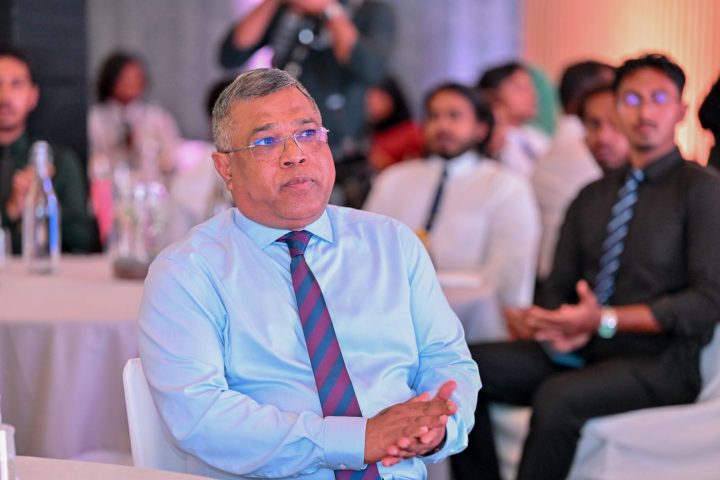
BML’s financial strength and national reach make it central to Maldives economy: Shareef
Bank of Maldives (BML) plays a central role in financing businesses, supporting national infrastructure and providing access to financial services across the country, its Managing Director and Chief Executive Officer Mohamed Shareef has said.
Speaking at the opening ceremony of the Youth Entrepreneurs Expo 2026 at Barceló Nasandhura on Wednesday, Shareef said the bank’s position was closely connected to the performance and stability of the Maldivian economy.
BML provides services on every inhabited island, with its network extending from HA. Thuraakunu in the north to S. Gan in the south, he said.
Shareef described the bank as an institution established by Maldivians for Maldivians, with a responsibility to provide modern, reliable and inclusive financial services regardless of where customers live.
He said misinformation intended to create a negative perception of BML could have consequences beyond the bank because of its close links with households, businesses and the wider economy.
“Bank of Maldives is deeply connected to the Maldivian economy,” Shareef said. “Statements intended to create a negative perception of the bank could cause extensive damage to both the bank and the economy.”
Shareef cited the bank’s financial position as evidence of its capacity to support economic activity.
BML’s capital has increased to over MVR 16 billion, while its total assets exceeded MVR 55 billion for the first time in 2025 and have since risen above MVR 60 billion.
The bank’s total loan portfolio has passed MVR 30 billion, while customer deposits have exceeded MVR 41 billion.
Shareef said BML’s capital adequacy ratio, a measure of a bank’s ability to absorb financial risks, was being maintained at more than three times the regulatory requirement.
The bank issued more than MVR 10 billion in new loans during 2025. A further MVR 8 billion was issued during the first six months of 2026.
Shareef said these figures demonstrated the bank’s contribution to economic growth and investment.
BML also supports contractors implementing government infrastructure projects. Shareef said the bank does not finance contractors solely because they are working on state projects, but because the companies create employment, conduct business and contribute to national development.
“Every contractor we finance provides employment to Maldivians,” he said. “Every project they carry out is a force that moves the Maldivian economy forward.”
The financing supports business growth, employment creation and improvements to living conditions, he added.
Shareef also defended BML’s participation in housing projects.
Housing remains one of the main social challenges facing Maldivian families, and projects financed in partnership with the government are expected to provide close to 4,000 apartments.
He said the figure represented 4,000 families receiving homes rather than merely a financial or construction target.
“If investing in housing projects is something for which we are criticised, we will accept that criticism with pride every day,” Shareef said.
The bank has also expanded its physical network in the atolls. Shareef said seven branches were being opened as part of the latest stage of the expansion programme.
BML has established 17 branches over the past two years under the programme.
The branches are intended to allow the bank to understand customers’ needs at island level, provide direct assistance and address problems closer to where people live.
Branch employees will also visit homes, businesses and neighbouring islands to explain banking products, promote financial literacy and raise awareness of scams, Shareef said.
He rejected claims that establishing branches and automated teller machines in the islands represented unnecessary expenditure.
Residents outside Malé should not have to spend time and money travelling by sea to obtain services that are easily available in the capital, he said.
“Every island in this country should receive banking services in the same manner as Malé,” Shareef said. “This is not an unnecessary investment. It is our responsibility.”
The bank also supports customers through different stages of their lives, including savings accounts for children, student cards from the age of seven, higher-education financing and facilities for young people entering employment or establishing businesses.
BML’s foreign-currency operations also have a direct bearing on economic activity.
Shareef said the bank is selling close to USD 80 million per month to customers and has provided USD 860 million in dollar loans to businesses, particularly the tourism industry.
In addition, the bank has introduced international accounts through its Swipe digital wallet, allowing customers to hold accounts in US dollars, pounds sterling and euros with individual International Bank Account Numbers.
The facility is intended to help freelancers, content creators and young entrepreneurs receive international payments.
More than 20,000 people are using Swipe, while over 3,300 businesses accept payments through the platform, according to Shareef.
At the expo, BML also introduced a MVR 1 billion youth entrepreneurship financing scheme for Maldivians between 18 and 30 years of age.
The scheme will combine financing with training, guidance and business-development support.
Shareef said investing in the skills and capabilities of young people was one of the most important investments that could be made in the future of the Maldives.
He said BML would continue expanding access to services and supporting sustainable economic growth as the country’s national bank.