




Rebuilding memory: How Christophe Groh’s Heritage Villas reimagine Maldivian architecture for a new era
In a tourism landscape often defined by speed, scale and standardisation, the Heritage Villas at The Barefoot in Hanimaadhoo offer a different proposition. They do not begin with the usual language of luxury development, nor with the promise of novelty for its own sake. Instead, they begin with a question: what happens when architecture looks backward in order to move forward?

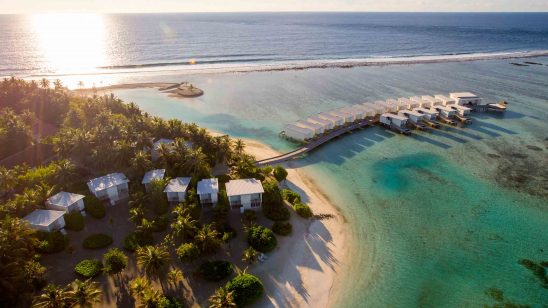
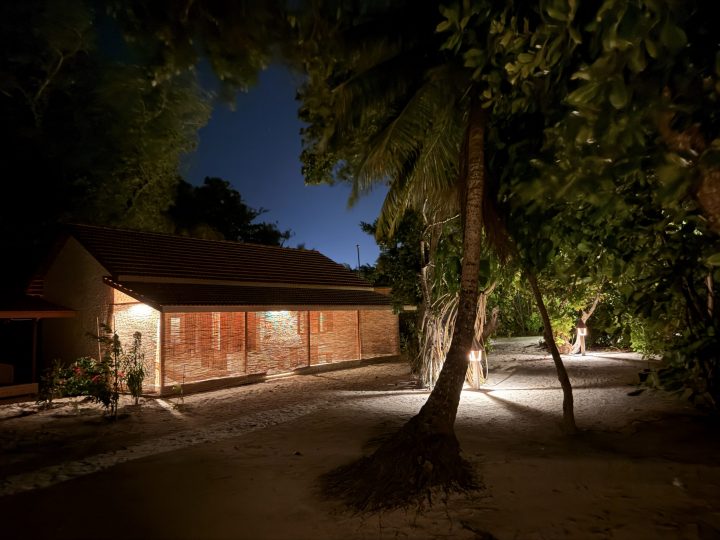
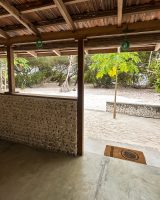
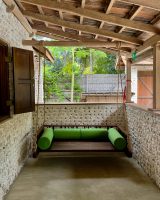
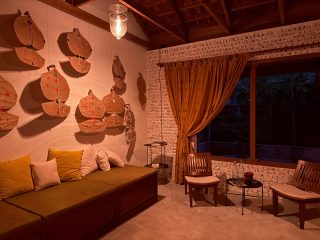
For Christophe Groh, owner and project lead, the answer lies in rebuilding a form of Maldivian house that once made complete sense for island life. The Heritage Villas are not presented as replicas frozen in time, but as working examples of how traditional knowledge, environmental logic and contemporary hospitality can meet in a way that feels both rooted and relevant. The project page describes the villas as an opportunity to “live the Maldives as the islanders once did”, with coral stone walls and coconut wood frames arranged around a central courtyard, inviting guests into a more direct relationship with climate, materials and place.
Groh’s motivation came from seeing how much of that architectural knowledge had already disappeared. In his interview, he explains that while travelling through the Maldives, from north to south, he found that many old houses had been abandoned, partly destroyed or completely lost. What stayed with him was not only the disappearance of physical structures, but also the fading of the logic behind them.
“The primary motivation was to rebuild a house, a Maldivian coral house, the way it used to be built, let’s say until the 1960s and 70s,” he says.
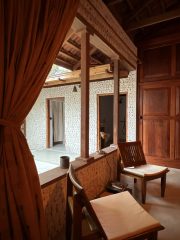
That ambition carries a practical argument as well as a cultural one. Groh wanted to demonstrate that the old coral house was not merely a relic of the past, but a sophisticated response to the conditions of island life. Thick coral walls, lime-based construction and cross-ventilation once allowed people to live without mechanical cooling. In a country where modern construction has become increasingly dependent on imported systems, sealed interiors and constant air conditioning, that point is not trivial.
“I wanted to prove that the concept of the Maldivian coral house was actually a very interesting concept for a sustainable way of living in the Maldives,” he says.
This is what gives the Heritage Villas their significance beyond hospitality design. The project is not nostalgia dressed up as experience. It is an architectural argument. It asks whether older building traditions, developed over generations of adaptation to heat, salt, wind and monsoon, might still have something important to teach the present.
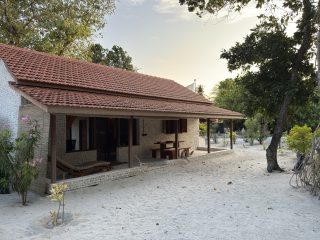
At The Barefoot, that inquiry began with one house. Groh first built an original coral house, designed by Mauroof Jameel, as a direct interpretation of how Maldivian homes once stood. That experiment then opened another possibility: if the house could provide comfort, atmosphere and natural airflow in contemporary conditions, why not extend the experience to guests interested in a different kind of stay?
According to Groh, some guests were already expressing a desire for accommodation that felt closer to traditional living and less dependent on air conditioning. For a hotel located on an inhabited island, rather than a private resort island, that interest made sense. Visitors were not only seeking a beach holiday; they were looking for a closer encounter with local life, landscape and culture.
From there, the idea evolved into a small collection of Heritage Villas. Their scale matters. Groh is explicit that this is not a project designed for mass replication. It is labour intensive, slow to build and commercially unappealing by conventional development standards. The point is not volume. The point is proof.
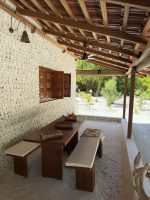
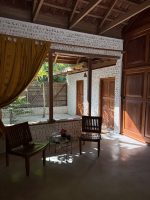
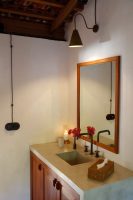
Architecturally, the villas balance fidelity and adaptation. Groh explains that the project retained the traditional model of a house divided into two parts, while opening up the patio to give guests more visual and physical access to the outdoors. Traditional family homes were designed for privacy, with more enclosed spatial arrangements. In the Heritage Villas, that logic has been adjusted to suit hospitality, allowing views toward the sea on one side and a private garden on the other.
The project page similarly notes that the house is arranged around a central open courtyard, with kitchen, storage room and bathroom on one side, and a bedroom and large living space on the other. The language is simple, but the design logic is layered: openness, ventilation, shade and rhythm are treated not as decorative gestures, but as core principles.
Groh also made deliberate choices about orientation. Traditional houses often had protective walls on the east and west in response to monsoon conditions. But in the guest villas, strict adherence to that model would have reduced sea views and sunset exposure. So the design was adjusted. This is where the project becomes especially interesting. It does not claim purity. It is honest about interpretation.
That honesty extends to material choices. “There is no cement,” Groh says. Coral was used for the walls, and coral lime for binding, in line with older methods. Local palm tree wood was used in the carpentry, and, as he puts it, “No nails. There is no iron in the construction, similar to traditional boat building in the Maldives.”
The technical detail is more than anecdotal. It points to a building culture that once worked with what islands could provide, and with methods designed for those materials. Groh explains that wooden nails were handmade from local wood, dried, briefly burned to harden them, and shaped using techniques once used in boat building in several atolls. Few people still know how to do this.
That scarcity is one of the project’s most important dimensions. The Heritage Villas are not only about preserving an architectural form. They are also about preserving skill. Groh says the team was fortunate to find an elderly carpenter in Hanimaadhoo who still knew these techniques, as well as two masons in their sixties and seventies. One of the goals was to keep that knowledge alive by transmitting it to younger workers.
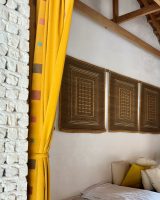
In this sense, the project operates as both construction and documentation. Groh describes recreating a traditional wooden partition between Beirogue and Terregue based on a very old house in Kulhudhuffushi, with a design resembling partition seen in Utheemu Palace. These are the kinds of elements most likely to disappear first when old homes are demolished. Recreating them is therefore not simply aesthetic. It is an act of recovery.
Even the furnishings follow the same logic of reuse and continuity. Furniture was made from recycled wood sourced from demolished houses in India, some of it 200 to 300 years old, then worked by carpenters on site. Old lamps from Cochin were also incorporated. Together, these elements give the villas a sense of age, not as styling, but as material continuity.
Yet Groh is careful not to romanticise discomfort. The villas include a fully air-conditioned bedroom, and the project page lists amenities such as high-speed wireless internet, a fully equipped kitchen, housekeeping and personalised services, alongside hotel access and curated experiences. The point is not to reject modern expectations altogether. It is to question which modern expectations are truly necessary, and which have simply become habitual.
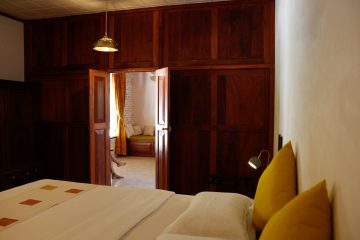
Groh’s own position is clear. “I want to convince people that it is not required,” he says of air conditioning. He notes that guests often need time to adjust. The first night may feel unfamiliar, with birds and waves audible from both sides of the island. But after two or three nights, many begin to understand the experience differently. “They say it is incredible, with absolute silence and only natural sounds.”
That period of adaptation may be one of the most revealing aspects of the project. It suggests that contemporary comfort has narrowed rather than expanded our sensory expectations. In relearning how to sleep with airflow, sound and porous space, guests are also relearning a different relationship with climate.
The ideal guest, Groh says, is someone looking for an environment close to nature. He speaks of travellers from countries where natural living already has cultural traction, and of guests who are not unsettled by geckos or the realities of being outdoors. But the market positioning is also philosophical. These villas are for people who want to engage, not merely consume.
That is why the in-villa kitchen matters. Groh says guests are encouraged to go into the village, buy ingredients and cook. Plans for a cooking lab and library are intended to deepen that experience, linking architecture with gastronomy and everyday practice. A traditional house, after all, is not only a structure. It is part of a way of life.
What message, then, does the project send to the Maldivian tourism industry?
Groh’s answer is careful but pointed. He says the aim is to encourage guesthouse owners and others to “rediscover what Maldives is”. Too many properties, in his view, rely on Western designs and imported materials that could belong anywhere from Miami to Kuala Lumpur. In doing so, they risk flattening the distinctiveness of place.
“People built houses in a certain way because they were perfectly adapted to island life,” he says. “Why introduce a universal design?”
It is a question with implications far beyond one hotel. In a country whose tourism image is globally recognised yet often detached from the textures of ordinary Maldivian life, the Heritage Villas offer another narrative: one in which development can be culturally grounded, environmentally responsive and small enough to remain meaningful.
This may not be the dominant future of tourism construction in the Maldives. Groh himself does not present it that way. But as a pilot, the project opens a valuable space for thought. It proposes that resilience is not only about engineering stronger structures or meeting new regulations. It is also about retaining knowledge that has already been tested by climate, geography and time.
If the villas succeed, their real legacy may not be the number of bookings they attract. It may be the fact that they make a forgotten architectural intelligence visible again. In that sense, the project is less about returning to the past than about restoring continuity between past and future.
And in a rapidly changing Maldives, that may be one of the most forward-looking ideas of all.