



Maldivian resort architecture: Mauroof Jameel’s exhibition traces five decades of island design
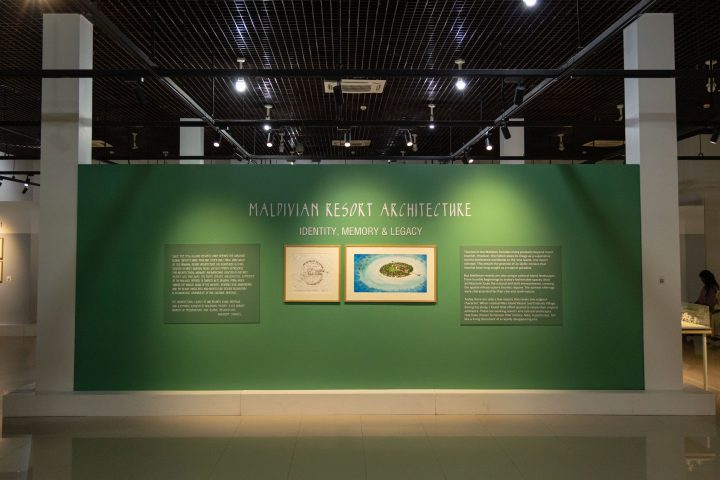
At the National Art Gallery in Malé, renowned architect, researcher and illustrator Mauroof Jameel is presenting a story that is both familiar and rarely told in full: the architectural evolution of the Maldivian resort.
For a country whose modern economy, international image and employment landscape have been shaped by tourism, the resort is more than a commercial product. It is a cultural form. It is an island settlement, a design experiment, a logistics model, a lifestyle stage, and, in many ways, one of the Maldives’ most globally recognised contributions to hospitality.
Mauroof’s exhibition on Maldivian Resort Architecture from June 3-18 examines this contribution across five decades, from the first island resorts of the 1970s to the high-design, branded, aerially spectacular properties of the 2010s. Hotelier Maldives visited the exhibition, which is supported by partners including Bestbuy Maldives (BBM), a long-time partner of Hotelier Maldives and a key supplier to the hospitality industry.
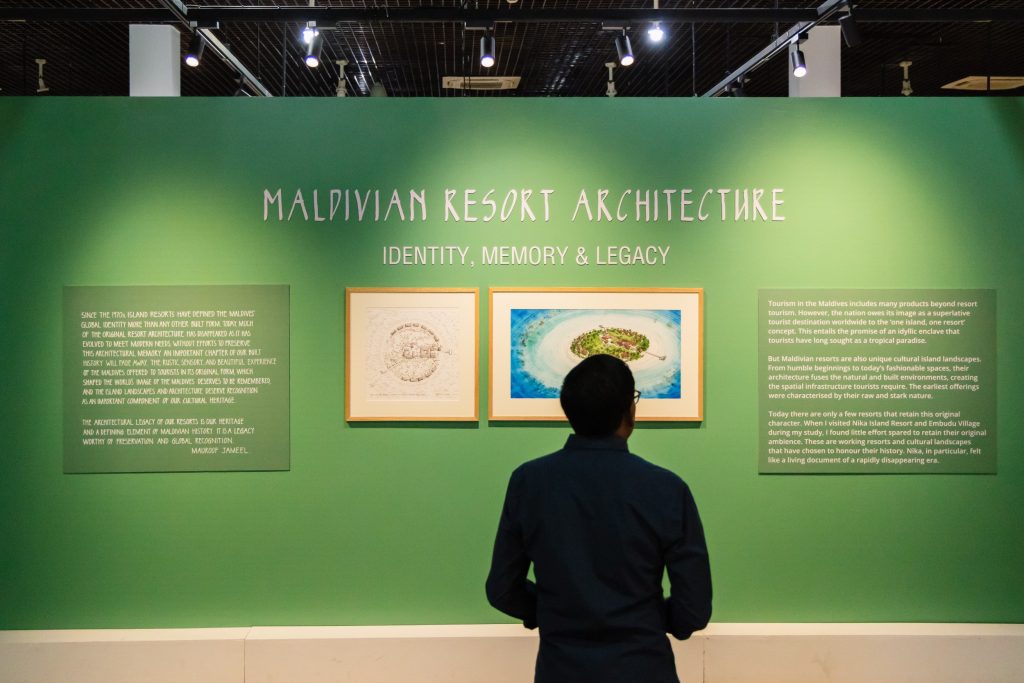
What emerges is not simply a timeline of buildings. It is a layered account of how the Maldives invented, adapted and refined the “one island, one resort” model, and how architecture became central to the destination’s identity.
The exhibition is arranged across thematic and chronological sections: “Interaction: Heritage”, “1972–1981: Origin”, “1982–1991: Refinement”, “1992–2001: Ambition”, “2002–2011: Spectacle”, “2012–2021: Glamour”, and “Memory and Legacy: Preservation”. Together, they present resort architecture as a form of living heritage, shaped by geography, tourism markets, local craft, imported systems, environmental constraints and the ambitions of designers, hoteliers and investors.
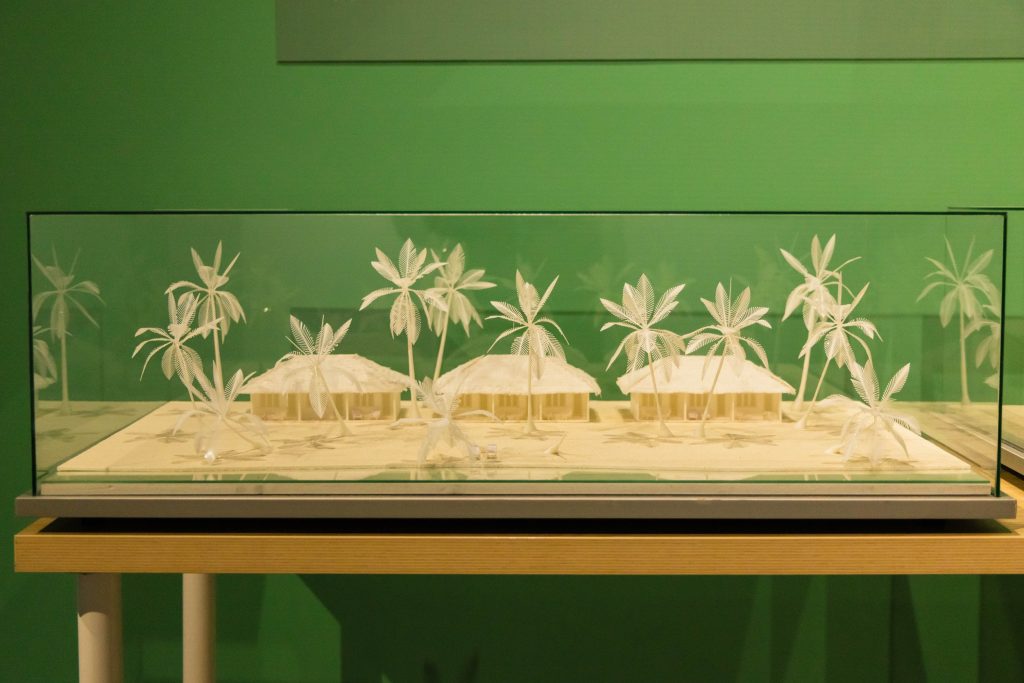
The opening sections return to 1972, when the first tourists arrived at Kurumba Village. As the exhibition notes, they did not find a resort in the conventional sense. What they encountered was an island with basic services, rough conditions and a form of tropical simplicity that would later become central to the Maldives’ appeal. For tourists, the dream of a Robinsonade holiday was fulfilled. For Maldivians, the first resorts introduced a new way of living on islands and a new way of appreciating the sea, sand and beach.
From the beginning, the Maldivian resort developed as a direct response to geography. The “one island, one resort” concept emerged not merely as a branding idea, but as a practical solution. An island already had natural boundaries. It required its own infrastructure: jetty, arrival pavilion, guest accommodation, restaurant, kitchen, store, staff quarters, powerhouse and dive school. Guest rooms faced the beach, a feature absent in pre-tourism Maldivian buildings, where island life had traditionally been organised differently.
The exhibition identifies two early design strands. One drew from vernacular construction, including coral stone masonry, coconut thatch and sand floors. The other used locally available modern materials such as corrugated metal roofing, galvanised iron pipes, plastered masonry and cement floors. These two approaches — an evocative vernacular and a practical modernism — would continue to evolve and intersect over the next 50 years.
By the 1980s, the industry had gained scale. The exhibition notes that by 1980, 37 resorts offered a combined bed capacity of 3,228. The dominant model remained the inclusive resort, with names such as Kurumba Village, Bandos Island Resort and Velassaru Tourist Resort among the leading examples. Other properties, including Alimatha Aquatic Resort, Vaadhoo Diving Paradise and Embudu Village, focused on diving, while Kuramathi Tourist Resort, Kuredhu Island Resort and Little Hura offered more basic camping-style facilities.
The decade also brought experimentation. Farukolhufushi operated briefly as a nudist resort, while Furanfushi ran for a time as a casino resort. More significantly, Cocoa Island opened as the Maldives’ first boutique resort, with just six rooms and a focus on privacy. Its guests included international figures such as Leni Riefenstahl, Boris Becker, Phil Collins and Brooke Shields, helping establish the Maldives as a destination for discerning travellers.
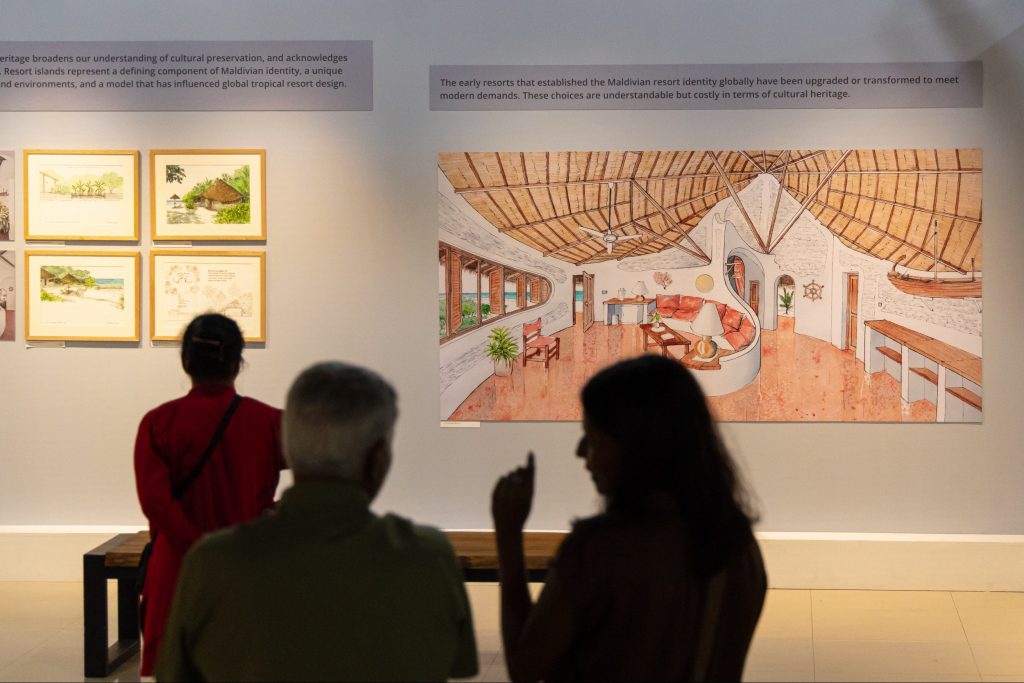
The “1982–1991: Refinement” phase shows an industry improving across almost every operational and design dimension. Transport, communication, food supply and construction became more reliable. Buildings became more diverse and more refined. Construction and material quality improved, while designers began giving greater thought to the relationship between indoor and outdoor spaces. Rattan furniture became a prominent decorative element, and landscape gardening, beach cleaning and ecological awareness began to influence resort environments.
By 1991, there were 62 resorts with a combined bed capacity of 7,855. The all-inclusive resort remained dominant, but smaller, high-end properties were gaining ground. European tour operators, partners and designers had a lasting influence on Maldivian resort architecture. The exhibition highlights the collaboration between Maria Grazia Benati of Vacanze and Ahmed Saleem, which set new precedents for the exclusive small luxury resort. Italian designer and builder Giovanni Borga also played a significant role, particularly through Nika Hotel and Club Med Faru.
This period also marked the rise of Maldivian architects and designers. Names such as Ahmed Saleem, Maizan Hassan Maniku, Ahmed Abbas, Mohamed Shafeegu (Voyages), Mohamed Shafeeq (Sappé), Tekton’s Gasim and Rafeeg are identified as defining figures. Mauroof also locates his own entry into the profession within this period, making the exhibition both a researched historical account and a personal professional reflection.
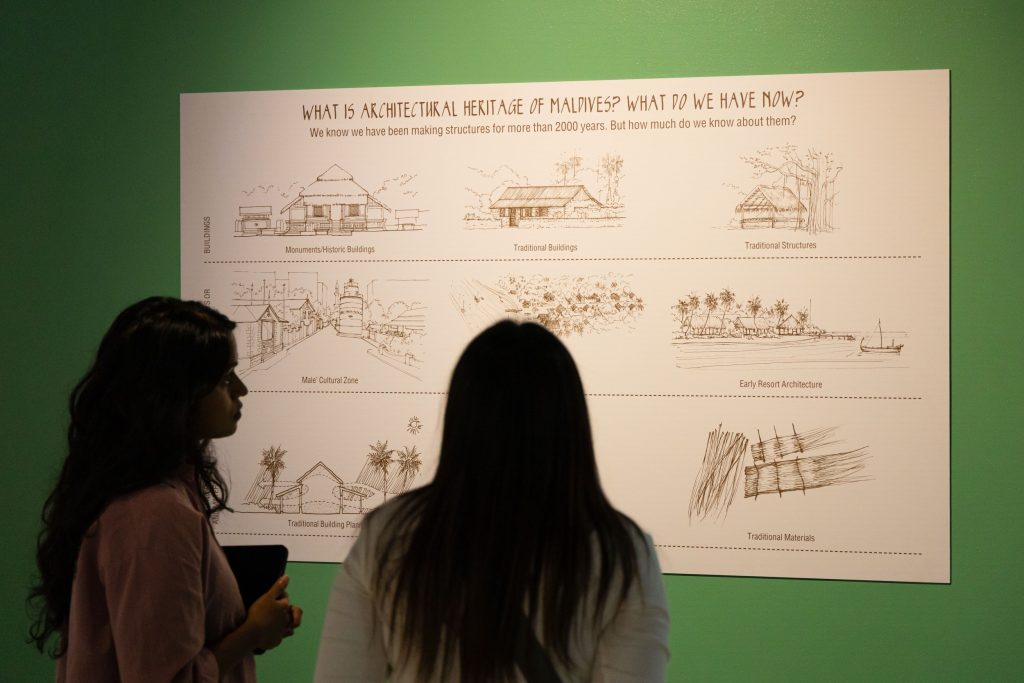
The next section, “1992–2001: Ambition”, captures a turning point. Resort architecture became more self-conscious, more luxurious and more diversified. The exhibition explains that this decade’s architectural evolution was shaped by aspirations for luxury and by the ban on coral mining. Imported building systems and prefabricated elements entered the scene. Interior design and landscaping were no longer afterthoughts. New architectural approaches emerged, including luxury eco-nature, luxury vernacular and luxury over-water styles. The first spa concepts arrived in 1995 and would go on to become a mainstay of the Maldivian resort product.
By 2001, there were 87 resorts with a bed capacity of 18,319, more than double the capacity at the start of the decade. The exhibition notes that the industry had discovered luxury and wellness, and that Maldivian resort architecture had moved beyond its early origins. The rustic vernacular that defined the first decade had not disappeared, but it was becoming the exception rather than the rule.
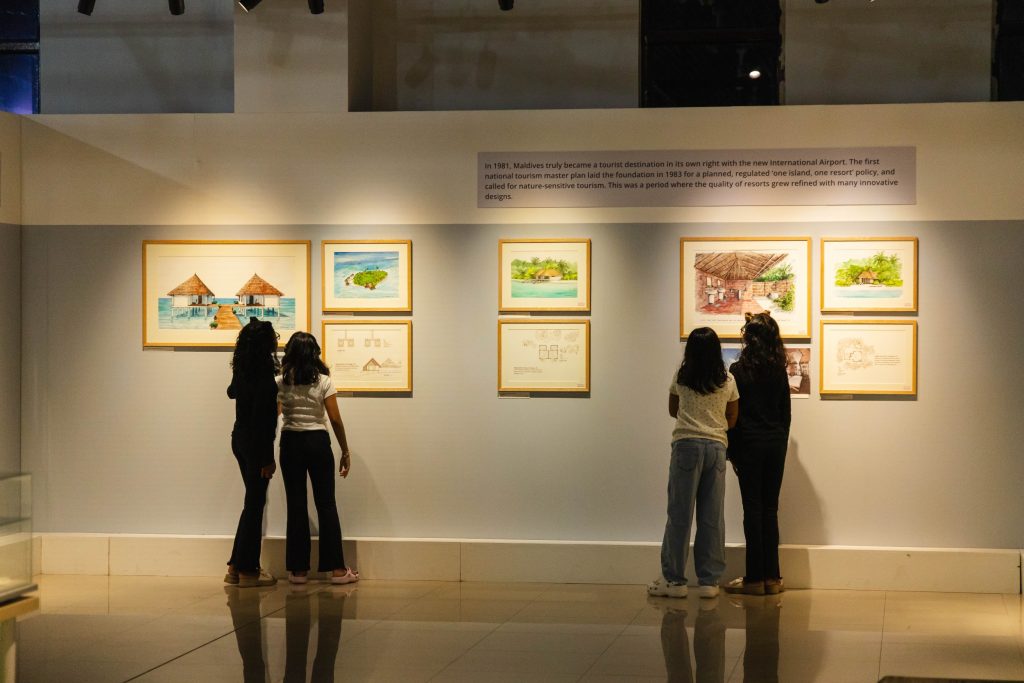
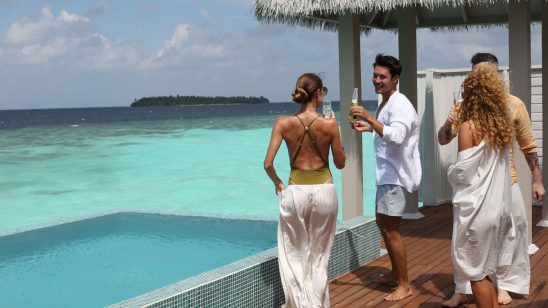
The “2002–2011: Spectacle” section charts perhaps the most dramatic phase of resort design. The sea, long the Maldives’ principal attraction, became an architectural frontier. The exhibition identifies the first underwater spa at Huvafen Fushi and the first underwater restaurant as engineering milestones that introduced new ways of experiencing the Maldivian marine environment. Global luxury brands and markets drove a higher level of design ambition. New expressions of the luxury vernacular style appeared alongside thematic and sustainable designs.
During this period, localised Tropical Modernism improved in resorts such as Paradise Island Resort and Sun Island Resort. Eclectic design and themed approaches also flourished. Banyan Tree developers introduced Balinese styles to Vabbinfaru, while Mauroof explored a local maritime theme, drawing on traditional boat forms and materials, in projects such as Ari Beach Resort, Hakura Huraa and Cocoa Island. The architectural language of the Maldivian resort was becoming plural.
The exhibition also acknowledges the expanding role of design practices. Local firms included Studio One, Tekton Design, Group X, Gedor Architecture, Design 2000, Riyan and Binarch. Overseas designers such as Dan Bube and Architrave also left their mark. By this point, resort architecture in the Maldives was no longer a single style, but an ecosystem of competing and overlapping design languages.
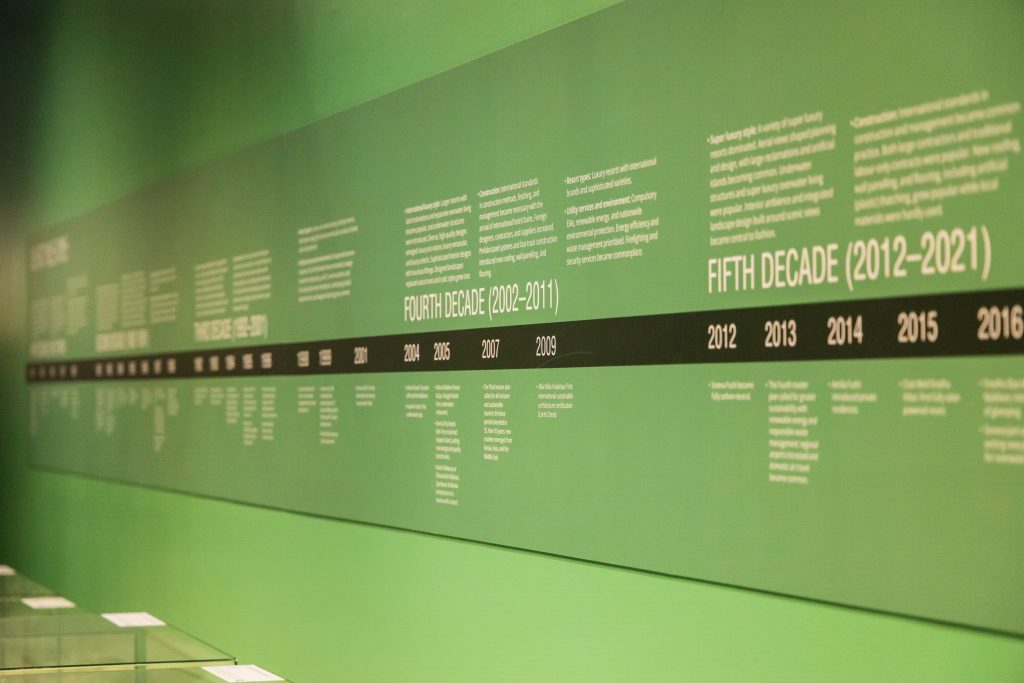
The final chronological section, “2012–2021: Glamour”, presents the fifth decade as the era of the iconic and the glamorous. Resorts became scenic, super-luxurious and highly visible, even from the air. This was the period of image-led luxury, where architecture, branding, landscaping and aerial photography increasingly merged into a single marketable identity.
Yet the exhibition does not treat this period only as a celebration. It notes that while responsible and sustainable design received greater attention, the same period also stood in contrast to extraordinary consumption of reef systems in the Malé region through reclaimed islands and the excessive transplantation of mature trees. This tension is one of the exhibition’s strengths. It recognises resort architecture as a source of national pride and global influence, while also asking what has been lost in the pursuit of spectacle.
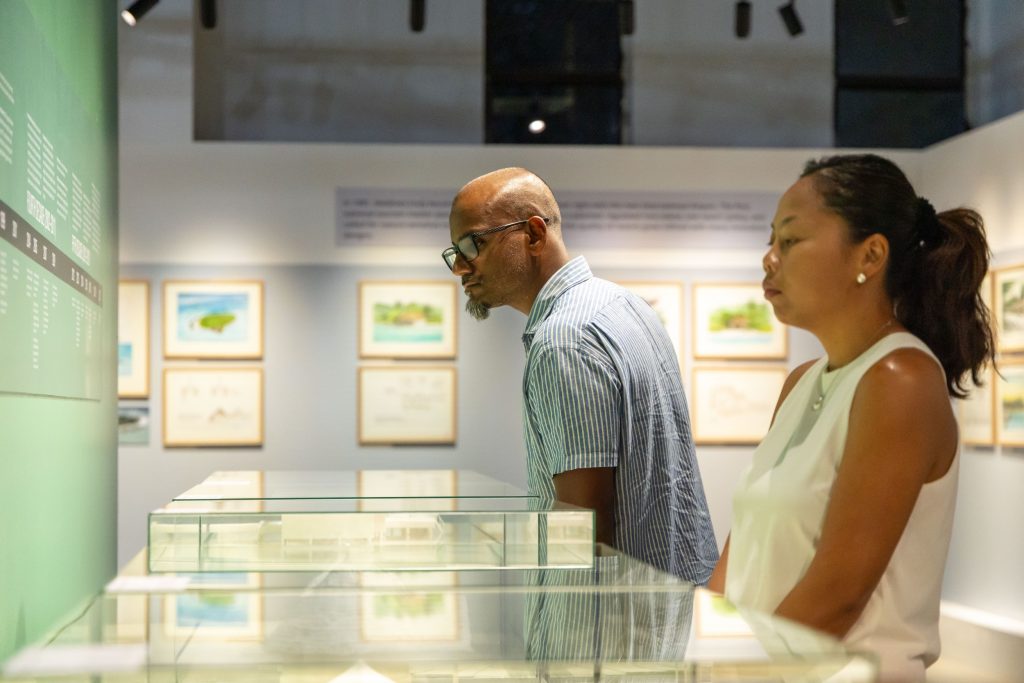
The closing section, “Memory and Legacy: Preservation”, brings the exhibition’s argument into sharper focus. Many of the early resorts that established the Maldivian resort identity have since been upgraded, transformed or replaced to meet modern demand. These choices are understandable, but the exhibition frames them as costly in terms of cultural heritage. Preserving and presenting the memory of the early resort experience, Mauroof argues, is important and can be accommodated alongside contemporaneity.
The most compelling example is Nika Island Resort. Opened in 1983, its organic coral stone structures, winding sandy pathways and original design vision remain remarkably intact after more than 40 years. For Mauroof, walking through Nika today offers an experience no archive can replicate. It is both a working resort and a national living heritage site. He argues that Nika merits consideration for UNESCO World Heritage status, recognition that would affirm the outstanding universal value of the Maldivian resort tradition.
This is the exhibition’s larger proposition: that Maldivian resort architecture deserves to be studied, documented and preserved as heritage. The Maldives introduced the world to the “one island, one resort” concept and the barefoot luxury model of enclave tourism. It remains a global leader in this space. But global recognition of Maldivian resorts as custodians of the barefoot luxury model would also underline the cultural identity embedded in the country’s tourism history.
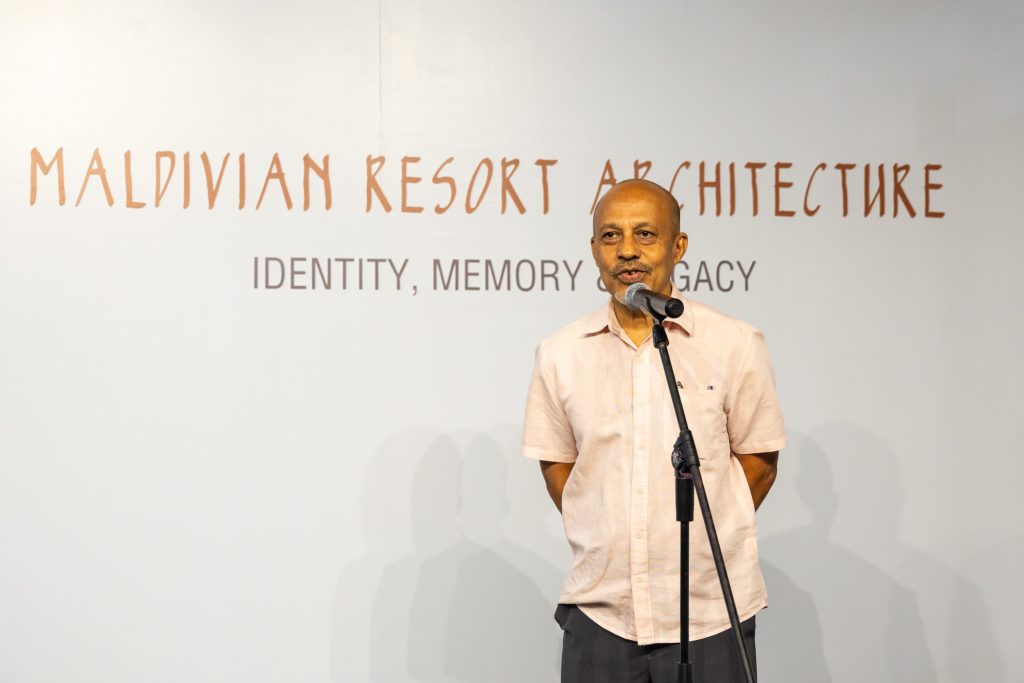
The exhibition is timely. As the industry continues to expand, renovate, rebrand and reposition itself for new generations of travellers, Mauroof’s work offers a reminder that the resort is not only a product to be refreshed. It is also a memory to be protected.
The exhibition invites resort owners, developers, operators, architects, suppliers, policymakers and tourism professionals to see the island resort as part of the Maldives’ cultural record. That includes the humble arrival pavilion, the thatched roof, the beach-facing room, the over-water villa, the underwater restaurant, the spa, the landscaped path, the staff quarters and the service infrastructure hidden behind the guest experience.
In doing so, Mauroof Jameel has created more than an architectural exhibition. He has opened a conversation about how the Maldives should remember the very spaces that made it visible to the world.
Photos: Next Media Group Pvt. Ltd.