





From billing clerk to materials manager: Ali Shareef’s 25-year journey in procurement, learning at Angsana Velavaru
Procurement rarely takes place in view of the guest. It operates through purchase orders, supplier negotiations, quality checks, stock controls, delivery schedules and the movement of goods between Malé and resort islands. Yet almost every part of a resort operation depends on it.
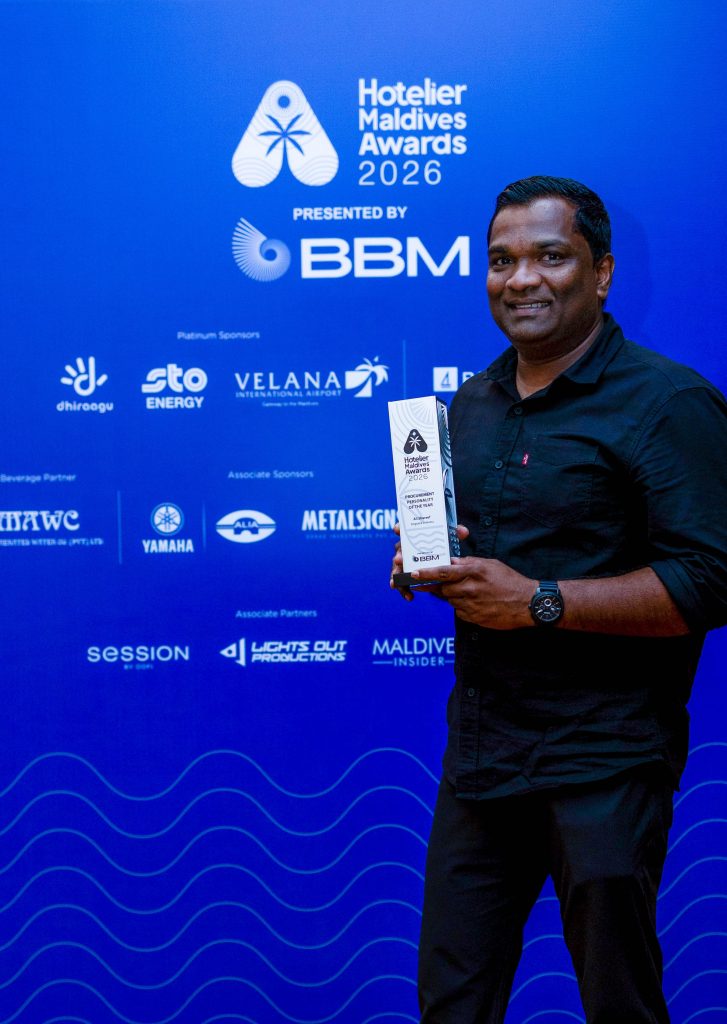
At Angsana Velavaru, the responsibility for coordinating this process rests with Materials Manager Ali Shareef, the recipient of the Procurement Personality of the Year award at the Hotelier Maldives Awards 2026.
Ali oversees the purchasing requirements of the 113-room resort in Dhaalu Atoll. From food supplies and operational equipment to spare parts and project materials, every item that enters the resort passes through a process managed by him and his team.
“Everything that comes here, from a single screw to a project, I am in charge of it,” he says.
His role today is the result of a career built through a succession of positions at the same property. Ali joined the resort when he was around 16 years old, arriving from the nearby island of Dhaalu Meedhoo without prior knowledge of the hospitality sector.
His home island, which he says had a population of about 900 people at the time, can be seen from Angsana Velavaru. Although the distance between the two islands was not great, the working environment he entered was different from the community in which he had grown up.
“When I joined, I was very nervous because I did not know the people,” he recalls. “I came from a small island, and when I joined here, I saw so many people from different countries. There was a diverse team.”
The change was enough to make him reconsider his decision almost immediately.
“On the second day, I wanted to leave because I did not have confidence at that time,” Ali says.
Support from colleagues, including people from his own island and neighbouring communities, helped him remain at the resort. They guided him through the first stage of his employment and gave him the confidence to continue.
He started as a billing clerk at the resort’s main bar. The position introduced him to hotel systems, cashiering and the relationship between front-of-house services and financial controls.
“At that time, I did not know what the hotel industry was,” he says. “Gradually, I was learning, studying and asking questions from different people. Within three or four months, I gained confidence and became comfortable with the job.”

His willingness to learn brought his first promotion within six months. Management asked him to move to the front office as a night auditor while continuing to handle cashiering duties.
The schedule required him to begin work at around 5pm. After completing the evening cashiering responsibilities, he would move into the night audit function at approximately 11pm or midnight. His shift continued until around 7am, when he also assisted with the departure of early-morning guests.
“I had to do cashiering and then come to the night audit,” he says. “By the time I finished, it was around seven in the morning, and I had to handle the early departures. It was a long working hour, and I was around 17 years old.”
Ali remained in the combined role for about a year. He was then promoted to accounts assistant, adding another area of hotel operations to his experience.
Although his early positions were not directly connected to procurement, they provided a foundation in revenue handling, reconciliation, documentation and control. They also allowed him to understand the way departments depend on one another.
His route into procurement began when he became a storekeeper.
“Procurement starts from the store,” Ali says. “As a storekeeper, I started learning the store operation. We had a good team, and I was learning from them.”
The store is where purchasing decisions meet resort operations. Orders must correspond with stock levels, consumption patterns and departmental requirements. Deliveries must be checked, recorded, stored and issued. Errors in purchasing can result in shortages, waste or added transport costs.
After about a year as storekeeper, Ali was promoted to purchasing coordinator. He subsequently progressed through the positions of assistant purchasing manager and purchasing manager before taking responsibility as materials manager.
Each move expanded his understanding of the supply chain, from receiving and storage to sourcing, purchasing and project requirements.
“I achieved the position of materials manager by going through many positions,” he says. “When I look at the journey, coming from a small island and overcoming these stages is one of the things that remains most memorable to me.”
Managing the island supply chain
Procurement at an island resort requires planning around distance, transport capacity and the availability of products in the Maldives.
Angsana Velavaru receives its main supply shipment once a week. Ali must ensure that departmental orders are confirmed, sourced and placed on the scheduled boat. Missing an item can affect operations for several days and may require another method of transport.
“We are far from Malé, and we have to buy almost everything from Malé,” he says. “We can obtain some items from nearby islands, but it is limited.”
Produce such as bananas and watermelons may be available from local communities, depending on the season and supply. Most food products, engineering materials, housekeeping supplies, guest amenities and project items, however, must travel from Malé or be imported through suppliers based there.
“I have to be careful about what is coming to the hotel,” Ali says. “Every week, I have to make sure that everything is on that boat. When something is missing, it becomes a challenge because we cannot always get it from a nearby island.”
Sending supplies by seaplane is not a routine alternative. Space, weight, handling requirements and restrictions on particular items limit what can be transported.
“There may sometimes be a possibility of bringing something by seaplane, but there are many challenges,” he says. “We have to make sure the items come on the supply boat, that they are checked on time and that we deliver what the respective head of department has requested.”
Ali is the only employee dedicated to purchasing at the resort. He works with a senior storekeeper and a receiving clerk, while retaining oversight of purchasing, receiving and stores.
“On top of purchasing, I have to handle receiving and the store as well,” he says. “Basically, I have three responsibilities.”
The size of the team means that coordination and record-keeping are part of his daily work. Requests must be assessed against stock, operating needs and budgets. Suppliers must be contacted, quotations reviewed and delivery arrangements confirmed. Once goods arrive, the team must inspect them, verify quantities and issue them to the relevant department.
Ali says the workload became more manageable as his knowledge of the resort, its consumption patterns and its suppliers developed.
“When I started, it was difficult because I was learning,” he says. “I studied and overcame the challenges. Now it is easier for me to handle because I understand the operation and I am the person doing the purchasing.”

Quality, value and control
A resort purchasing department is expected to balance cost, product specifications, operational deadlines and guest expectations. The lowest quotation does not always provide the required value, particularly when product quality, shelf life, transport conditions or replacement costs are taken into account.
Ali says suppliers must follow the resort’s purchasing requirements rather than sending substitutes or items that do not meet the specifications.
“They cannot just send whatever they want,” he says. “We have procedures and policies they have to follow. When we order something, they have to follow our guidance.”
Inspection at the receiving stage is one of the controls used to maintain standards. This is particularly relevant for fruit, vegetables and other products whose condition can change during transport.
“We have to check whether what they deliver meets our quality and our standard,” Ali says. “Sometimes, a supplier may send an item that is not of the required quality. We have to reject it at the same time and address it.”
He notes that the resort generally receives products that meet its requirements. The larger challenge is often availability within the Maldives, where many goods must be imported and suppliers may have limited stock.
“The main issue is the limitation of the country,” he says. “Sometimes it is difficult to get the item. Quality matters because guests expect the service and product they have paid for. We have to deliver according to that expectation.”
Company policies also guide purchasing decisions and controls across the operation. Ali considers adherence to these procedures one of the main requirements of his position.
“We have policies and procedures implemented for the whole group,” he says. “As a purchasing manager, it is important that I commit to them and work according to the company’s procedures.”
This includes maintaining documentation, obtaining the required approvals, comparing suppliers and ensuring that goods received correspond with what was ordered. Such controls support financial accountability while reducing the risk of over-ordering, unauthorised purchasing or stock discrepancies.
Recognition built over time
Before receiving the Procurement Personality of the Year award, Ali had been named Manager of the Quarter at Angsana Velavaru on four occasions. His latest recognition under the programme came during the first quarter of 2025.
“When you are recognised and appreciated for what you do, it is an achievement,” he says. “Among different managers, your work is highlighted and appreciated. I believe my work and contribution were recognised, and it was a happy moment.”
The Hotelier Maldives Awards 2026 extended that recognition beyond the resort. For Ali, the award represented acknowledgement of work carried out over 25 years, much of it away from areas normally associated with the guest experience.
“I have been working here for 25 years, and I was very happy that I received this award because what I am doing was appreciated across the Maldives,” he says. “When you do something, appreciation and recognition are important.”
He credits the resort’s management and his colleagues for supporting his development. Ali thanked General Manager Ahmed Zahir, Financial Director Sena Senaratne, his procurement colleagues and the wider Angsana Velavaru team for their role in his career.
“During my whole journey, from the time I joined this hotel, they have helped me a lot,” he says.
A route for Maldivian talent
Ali believes procurement, stores and finance provide career opportunities for Maldivians, although these departments receive less attention than guest-facing roles.
“Back-of-house jobs are limited in the Maldives, and sometimes people may not want to sit in an office,” he says. “It depends on what you are interested in. Some people are interested in the front line and some in the back office.”

He encourages young people to consider roles in purchasing, stores and finance, where they can develop technical knowledge and move into management.
“There are opportunities to grow,” he says. “Working in stores, purchasing or finance can provide a career, and the salary can also be good. Take the challenge and show that we can do it.”
The main lesson from his own career, he says, is the need to move beyond familiarity. His progression did not come through one fixed career plan. It came through accepting positions, learning new systems and taking responsibility when opportunities arose.
“Do not try to remain in your comfort zone,” Ali says. “Come out, challenge yourself, learn and grow. Some people want to stay in the same place, but my advice is to take different roles. Do not sit in the same chair all the time.”
For Ali, learning remains a daily part of hotel operations, even after 25 years.
“From the day we are born, we have to learn,” he says. “Every day is a journey in which we learn.”
His career began with uncertainty during his second day at the resort. It continued through billing, night auditing, accounts, stores and purchasing. Today, the teenager who once considered returning home manages the flow of supplies that allows Angsana Velavaru’s departments to operate.
The work may remain behind the scenes, but its effect is present across the resort — in every room, restaurant, maintenance task and operational project.