




World Environment Day: How Maldives became a global leader in sustainable tourism – and what comes next
On a nation of low-lying coral islands, sustainability is not a marketing strategy. It is a necessity.
As the world marks World Environment Day on June 5, the Maldives stands as one of the tourism industry’s most compelling sustainability success stories. Over the past two decades, the country has transformed itself from a luxury beach destination into a global showcase for environmentally conscious tourism, where marine conservation, renewable energy, reef restoration and responsible hospitality have become integral to the guest experience.
Today, many of the Maldives’ leading resorts are no longer judged solely by the quality of their villas, dining concepts or service standards. Increasingly, their environmental credentials have become equally important, reflecting a broader shift in traveller expectations and global tourism trends.
Yet while the Maldives has earned international recognition for its sustainability efforts, the question facing the industry today is no longer whether it can lead—but how it can strengthen that leadership in an increasingly complex environmental landscape.
A Sustainability Pioneer in Island Tourism
Long before sustainability became a global tourism buzzword, many Maldivian resorts were already implementing environmental initiatives out of necessity. Operating on remote islands required careful management of limited resources such as freshwater, energy and waste.
Over time, these operational realities evolved into a broader sustainability movement.
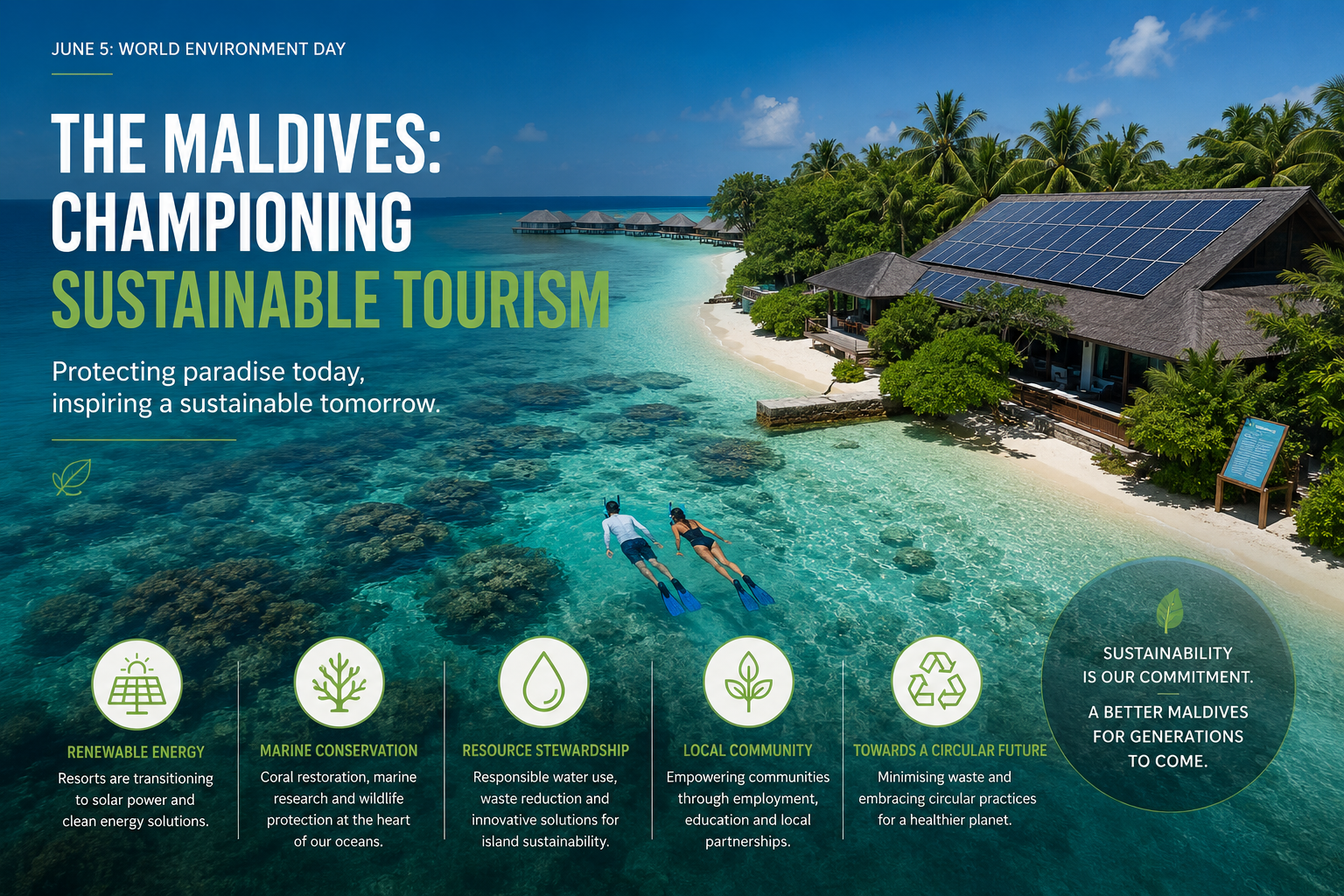
Today, numerous resorts operate marine conservation centres, coral nurseries and reef restoration programmes. Guests are invited to participate in coral planting, sea turtle monitoring, manta ray research and citizen science projects that contribute directly to marine conservation.
Several resorts have partnered with international NGOs, marine biologists and research institutions to protect fragile ecosystems while educating visitors about the importance of ocean stewardship.
The country’s unique “one island, one resort” model has also provided a powerful platform for environmental management. Unlike many mass tourism destinations, individual resorts often maintain direct responsibility for the health of their surrounding reefs, lagoons and beaches, creating a strong incentive for sustainable practices.
Investing in Renewable Energy
One of the most visible examples of the Maldives’ sustainability journey has been the growing adoption of renewable energy.
Across the country, solar arrays now appear on resort rooftops, staff villages, service buildings and even floating platforms. Hybrid energy systems are helping reduce dependence on diesel generators, lowering both operational costs and carbon emissions.
For many resorts, solar power has become a practical demonstration of climate leadership. Some properties now generate a significant proportion of their daytime electricity needs from renewable sources, while battery storage technologies are beginning to improve efficiency and resilience.
As climate change poses an existential threat to small island nations, these investments carry symbolic significance as well. They demonstrate that tourism businesses can become part of the solution while maintaining luxury standards.
Conservation as Part of the Guest Experience
Modern travellers increasingly seek meaningful experiences that connect them with local environments and communities.
The Maldives has been particularly successful in integrating conservation into the guest journey.
Marine discovery centres, sustainability tours, coral adoption programmes and wildlife excursions have transformed environmental education into memorable guest experiences. Rather than treating sustainability as a back-of-house function, many resorts have placed it at the centre of their brand identity.
This approach benefits both conservation and business. Guests gain a deeper understanding of the natural environment they are visiting, while resorts create distinctive experiences that differentiate them in an increasingly competitive luxury market.
The result is a tourism model where environmental protection becomes part of the product itself.
The Challenges Ahead
Despite significant progress, substantial challenges remain.
The Maldives continues to face high energy costs, dependence on imported goods, growing waste volumes and increasing climate vulnerabilities. The expansion of tourism infrastructure also places additional pressure on marine ecosystems and natural resources.
Plastic reduction initiatives have achieved notable success, but waste management remains one of the industry’s most pressing concerns. The transportation, treatment and disposal of waste across a dispersed island nation presents logistical and financial challenges unlike those faced by many other destinations.
Water production is another resource-intensive process. Desalination systems are essential for resort operations but require significant energy inputs. Balancing luxury guest expectations with resource conservation will remain an ongoing challenge.
Meanwhile, coral bleaching events linked to rising ocean temperatures continue to threaten reefs that underpin the country’s tourism appeal.
Strengthening the Maldives’ Leadership
To maintain its position as a global sustainability leader, the Maldives tourism industry must move beyond individual initiatives towards broader systemic transformation.
Greater investment in renewable energy could significantly reduce the sector’s carbon footprint. Industry experts increasingly point to the need for larger-scale solar deployment, battery storage systems and emerging clean energy technologies that can reduce dependence on imported fossil fuels.
Local sourcing presents another opportunity. While some resorts have developed hydroponic farms, organic gardens and partnerships with local producers, expanding these efforts could strengthen food security, reduce transportation emissions and generate greater economic benefits for island communities.
The industry can also deepen its commitment to the circular economy by reducing waste generation at source, improving recycling systems and exploring innovative solutions for construction materials, food waste and packaging.
Environmental certification programmes and transparent sustainability reporting will become increasingly important as travellers, investors and regulators demand measurable outcomes rather than broad commitments.
Perhaps most importantly, sustainability must continue to evolve from a specialised department into a core business strategy embedded across operations, procurement, design, guest experiences and long-term investment planning.
A Global Example for Sustainable Tourism
The Maldives occupies a unique position in the global tourism industry.
Few destinations are as dependent on a healthy natural environment. Few have as much at stake in the fight against climate change. And few have demonstrated as clearly that luxury tourism and environmental responsibility can coexist.
World Environment Day serves as a reminder that sustainability is not a destination but a journey.
The Maldives has already shown the world what responsible island tourism can look like. The next challenge is to build on that foundation, creating a tourism model that is not only environmentally responsible but also resilient, regenerative and capable of inspiring destinations around the world.
For an industry built upon the beauty of pristine oceans, vibrant coral reefs and untouched island landscapes, protecting the environment is more than an obligation—it is an investment in the future of Maldivian tourism itself.