



Mohamed Hussain Shihab: Building HR leadership through people, succession and service
When Mohamed Hussain Shihab first considered hospitality, it was not part of a long-set career plan. He was looking at colleges in Malaysia when he came across a hotel school. That encounter changed the direction of his studies, and later his career.
“I didn’t plan on studying hospitality in the beginning,” Shihab says. “But while looking at colleges I came across a good hotel school there and that’s what first got me into hospitality.”
His first resort experience came through an internship at Conrad Maldives Rangali Island. It was during that placement that he began to understand the structure, pace and purpose of resort operations. The experience also gave him a clearer view of the Maldives tourism industry from within.
“My first resort experience was with Conrad Maldives as an intern and that’s where I fell in love with working on resorts and the industry itself,” he says.
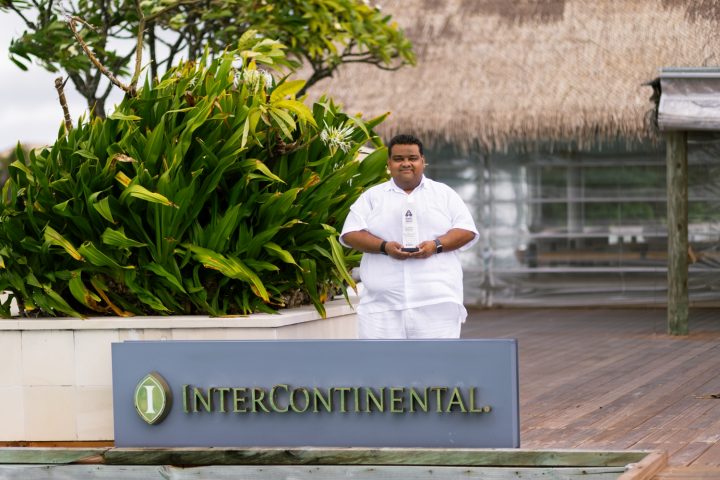
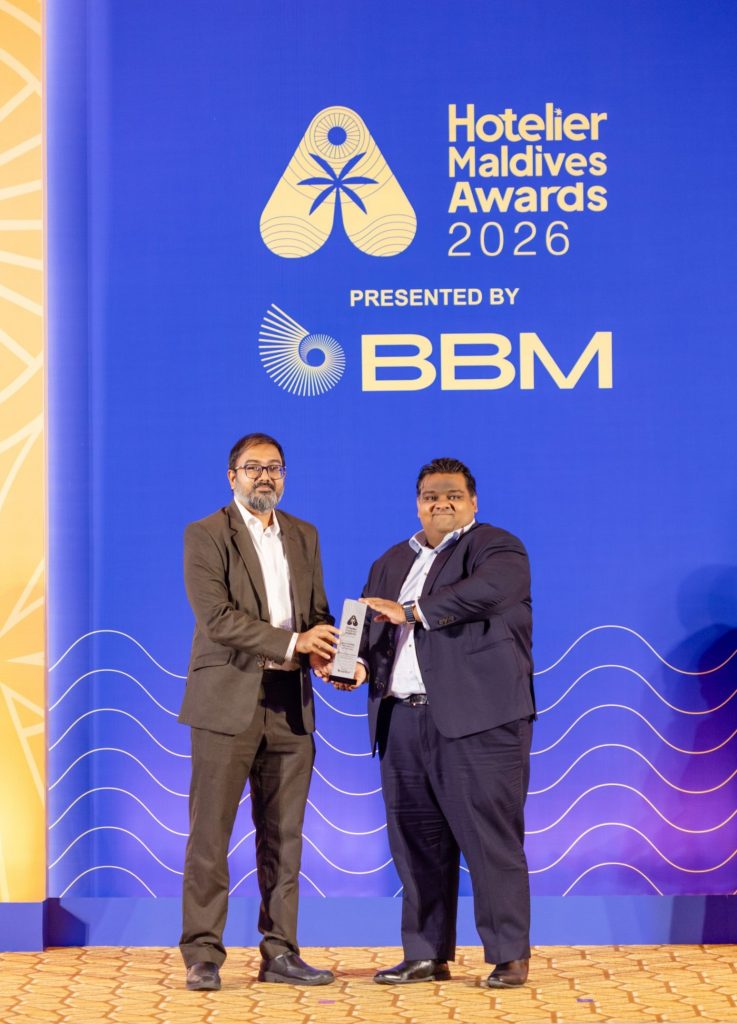
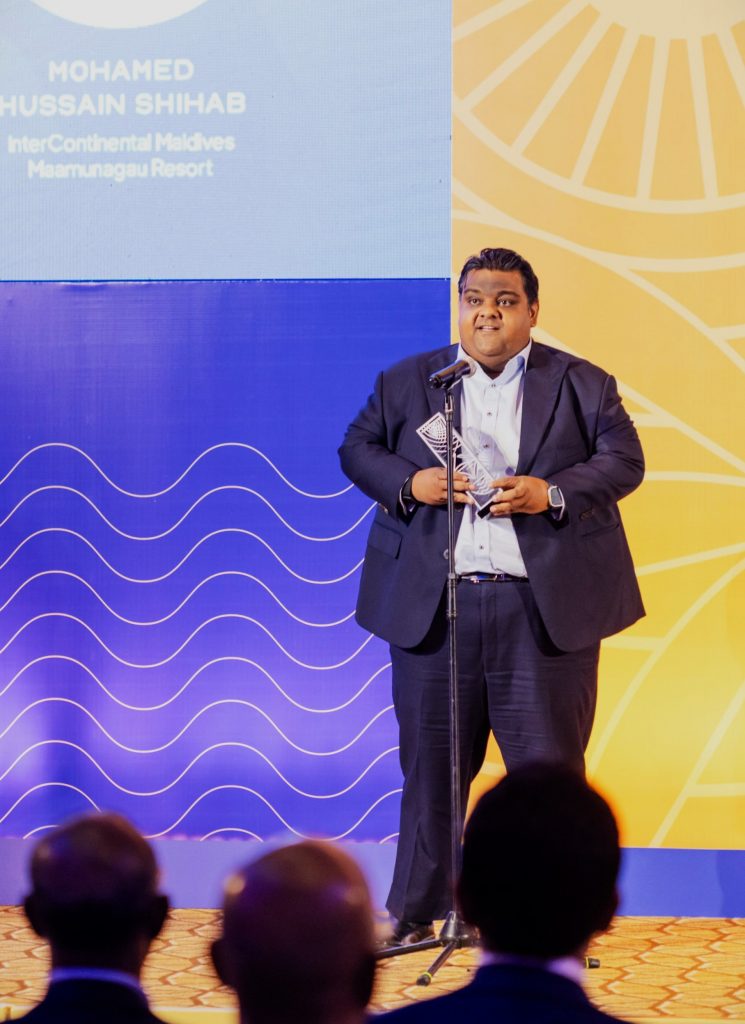
Today, Shihab is the Area Director of Human Resources for IHG Hotels & Resorts in the Maldives. His portfolio covers three properties, placing him in a role that requires oversight of people strategy, succession planning, policy alignment, colleague engagement and leadership development across resort operations. In 2026, he was recognised as HR & Training Personality of the Year at the Hotelier Maldives Awards, an acknowledgement of his contribution to human resources in the country’s hospitality sector.
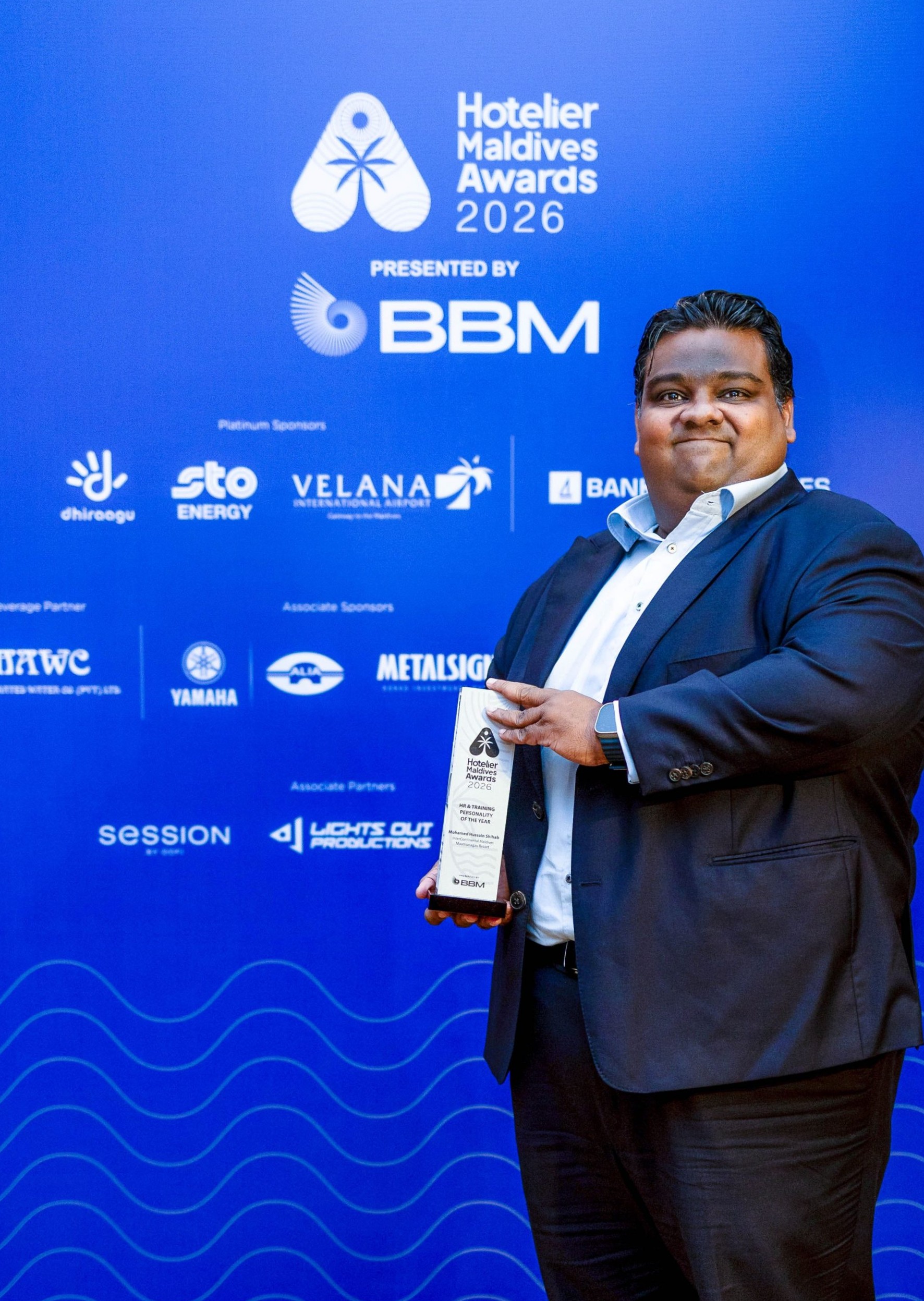
For Shihab, the award is not only a personal milestone. He views it as recognition of the teams he has worked with and the systems built around people development.
“Personally, to me, it just means that I’ve been doing a good job at leading the teams that report to me and giving it the best that I can,” he says. “But to the industry, I think it’s great to see the recognition from institutions like Hotelier Maldives for the passion that people have for the industry.”
Shihab’s entry into human resources was also not a predetermined decision. After entering hospitality, HR became part of his career through an opening that came at the right time. He was looking for a position with a local company when the opportunity arose.
“HR was not always my first option,” he says. “But because of an opportunity arising just while I was looking for positions and the right position with a local company, that’s what first got me into human resources. And since then, it’s been a very rewarding journey.”
That journey has taken him through several hospitality groups and operating environments. His early experience included Hilton, followed by Centara Hotels & Resorts, Anantara and later InterContinental Hotels Group. Anantara was the first major international brand he worked with. Each brand, he says, contributed to his understanding of hotel operations, people management and leadership in different contexts.
The defining moments in his career, however, are linked less to positions and more to people. Shihab points to leaders who shaped his view of HR and management, especially during the earlier stages of his career.
“For me, I would really say defining moments would actually be the people that have had an impact on my journey,” he says. “Starting with probably the best HR director I ever worked under when I was a junior in human resources, being Rizan Ali Afeef, who now works in the US. He really had an impact on what I always saw a good HR leader to be.”
He also refers to general managers who influenced his leadership approach, including Coetzer Deysel, Reinhold Johann, and Mark Eletr from Holiday Inn Resort Kandooma Maldives.
“They’ve really taught me about different styles of leadership and really emulated what a great leader should be,” he says. “Having impact from those leaders is really, I think, what’s made this journey more rewarding.”
For Shihab, HR is rooted in people, but also in consistency, process and law. He sees the function as one that must balance human connection with institutional responsibility. In resort environments, where colleagues live and work within the same island ecosystem, HR has a role that extends beyond administration.
“It’s all about people,” he says. “Leading the teams through showing them what is the right HR and what is the wrong HR or what I see as what we can do better.”
At the same time, he stresses the importance of structure in decision-making. Where there are disagreements on what is right or wrong, he believes HR leaders must return to the legal and regulatory framework.
“There is a lot of debate between right and wrong,” he says. “I think when it comes to those debates, we should look at what’s written as per law and guidelines to really be able to establish the right term of leadership.”
In his current role, Shihab’s day-to-day work has moved from operational HR involvement to broader planning. As Area Director, his focus is on the direction of people strategy across properties and the development of systems that support future growth.
“My day-to-day really now revolves around strategy and future planning for the path that the resort takes in terms of people strategy,” he says.
Even so, he remains connected to the operational side of HR. He says the day-to-day involvement with colleagues was part of what he enjoyed in earlier roles, and it continues to inform how he approaches his current responsibilities.
“Previously, of course, being involved in the day-to-day is more of what I used to do and what I still love,” he says. “Being able to oversee three properties and look at the people strategy and where these properties will go in the future really has an impact on what I do now on a day-to-day basis.”
One of the challenges of overseeing multiple properties is maintaining the human connection that is central to HR leadership. Resort operations in the Maldives depend on close working relationships, and HR leaders are often expected to understand colleague concerns, career goals and welfare matters at a personal level.
“I think the biggest challenge is trying to make sure that that human connection is still made,” Shihab says. “Because it’s so important, especially in a resort environment, that you build a human connection with each and every colleague.”
As an Area Director, time spent at each property is limited compared with a property-based HR role. Shihab says he manages this by travelling between properties and using each visit to engage with colleagues and leadership teams.
“In this role as an Area Director now it’s tougher, of course, because I get less time with each property,” he says. “But still trying to travel to each property as frequently as I can and build those connections while I’m there, that’s been the most rewarding part.”
A central part of Shihab’s HR work is succession planning. He views it not as a document or a yearly exercise, but as a process of identifying, preparing and promoting talent from within the organisation. He points to examples from the properties he oversees: a reservation agent becoming a reservation manager, a duty manager becoming director of rooms, and a colleague who began as a security guard becoming a security manager.
“You see the rewarding growth of colleagues in the industry,” he says. “So I think that has been the most impactful part of the succession planning for each property. And you see it evident here because all of those examples I just mentioned came out of these properties.”
In practice, succession planning requires a system that allows colleagues to move from entry-level roles into supervisory and management positions. Shihab says international hotel companies will continue to recruit externally when required, particularly as pipelines expand. But he believes the Maldives must continue to develop talent within resorts.
“In practice, it’s about growing talent from within,” he says. “We, of course, as a large international company, sometimes do have to look outside for talent because there are just so many hotels that we’re developing. IHG as a whole, now up to 7,000 hotels worldwide. But really for succession planning, it should come from within the resort.”
He uses InterContinental Maldives Maamunagau Resort as an example. Since opening six years ago, the property has seen colleagues who joined during pre-opening in line-level positions move into management roles.
“It’s very rewarding to see when we have so much development from where, for example, InterContinental Maldives opened six years ago and now we have colleagues who have been here since the pre-opening who started at line level become managers in senior roles such as the front office manager, the executive housekeeper, all who joined in line-level positions are now leading the resort from what it was,” he says.
For Shihab, this is the form of succession planning that has relevance for the Maldives. The country has a tourism sector that relies on a broad workforce, and local career growth remains a key industry issue.
“That is actually the effective succession planning that we should look at within the Maldives because we have talent that we can grow internally,” he says.
Shihab’s career also includes experience outside the resort model. His time in Dubai gave him exposure to a city hotel environment, which differed from the Maldives in both structure and daily operations. Unlike a resort, where colleagues live and work on the same island, a city hotel involves commuting, varied living arrangements and different engagement challenges.
“Dubai was definitely a very rewarding experience because it’s completely different from a resort environment,” he says. “Being based in a fast-paced city, a city hotel where it’s 300 plus rooms but in one structure. And it’s very different from resort life because you have to actually travel to work.”
The logistics of managing colleague engagement in that setting gave him another perspective on HR. It required HR systems that accounted for teams living across a city, rather than within one staff village.
“You have the logistics of having so many colleagues that live everywhere,” he says. “So in the city and trying to make a meaningful engagement strategy around that was very rewarding, very different from what you see in the Maldives.”
That experience, he says, gave him a wider understanding of hospitality as a global industry.
“To be able to go to a fast-paced city like Dubai and understand what the hospitality industry looks as a whole was the most rewarding part of that journey,” he says.
Recognition has come during Shihab’s career, but he sees it in relation to the sacrifices made along the way and the people who remain around him. He says staying grounded is made easier by friends who acknowledge success but also ask what comes next.
“Even with all the recognition that’s come from the career, it’s also on the opposite side,” he says. “It’s easy to see the sacrifices you made along the way. And I think having good friends that, even when you get recognition such as the one I recently received, are able to just look at you and say, okay, so what’s next?”
That question — what comes next — now shapes his own priorities as an HR leader. Shihab says his focus is on developing members of his team and preparing the next generation of HR leaders. He wants the properties he serves to remain in capable hands when he eventually moves into another role.
“For me personally now it’s about developing members of my team,” he says. “Because ultimately I would like to make sure that the property once I step into another role is left in the right hands and being able to grow that next generation of HR leaders to take over.”
He credits his HR team and the general managers he has worked with for supporting the vision that has been built within IHG in the Maldives.
“The team here also has been a very big part of my success, especially with InterContinental Hotel Group,” he says. “I have a great HR team that has been supportive of my vision from the beginning. Great leaders as general managers who supported that as well. And that’s, I think, one of the reasons that the culture we’ve built here is so special.”
For young Maldivians considering hospitality, Shihab believes the industry continues to offer a route into leadership. He acknowledges that many young people are now drawn towards entrepreneurship and starting their own ventures. He sees value in that mindset, but also believes more young people should consider what tourism can offer in terms of career progression, training and international exposure.
“There are vast opportunities, especially for our younger local generation, to come into the industry,” he says. “We are struggling with more local youth coming into the hospitality industry because I do get the norm of starting your own thing and that is very entrepreneurial of the current generation, which is great.”
His message to young people is to look closely at the country’s main industry before dismissing it. He believes discipline, time management and the right approach can take local talent into senior roles.
“They should take the time to see what the biggest industry in their country can give them and what benefits they could have from it,” he says. “Any local talent, young youth who has the discipline and the right mind frame of time management can easily go far in the hospitality industry and become a great leader.”
Shihab’s own career reflects that belief. From a student exploring college options in Malaysia to an intern at Conrad Maldives Rangali Island, and from a junior HR role to Area Director of Human Resources for IHG Hotels & Resorts in the Maldives, his path has been shaped by opportunity, mentorship, operational learning and a focus on people.
His recognition as HR & Training Personality of the Year at the Hotelier Maldives Awards 2026 marks one point in that journey. But his focus remains on what follows: building teams, strengthening succession, and ensuring that more Maldivians see hospitality not only as a job, but as a career through which they can lead.